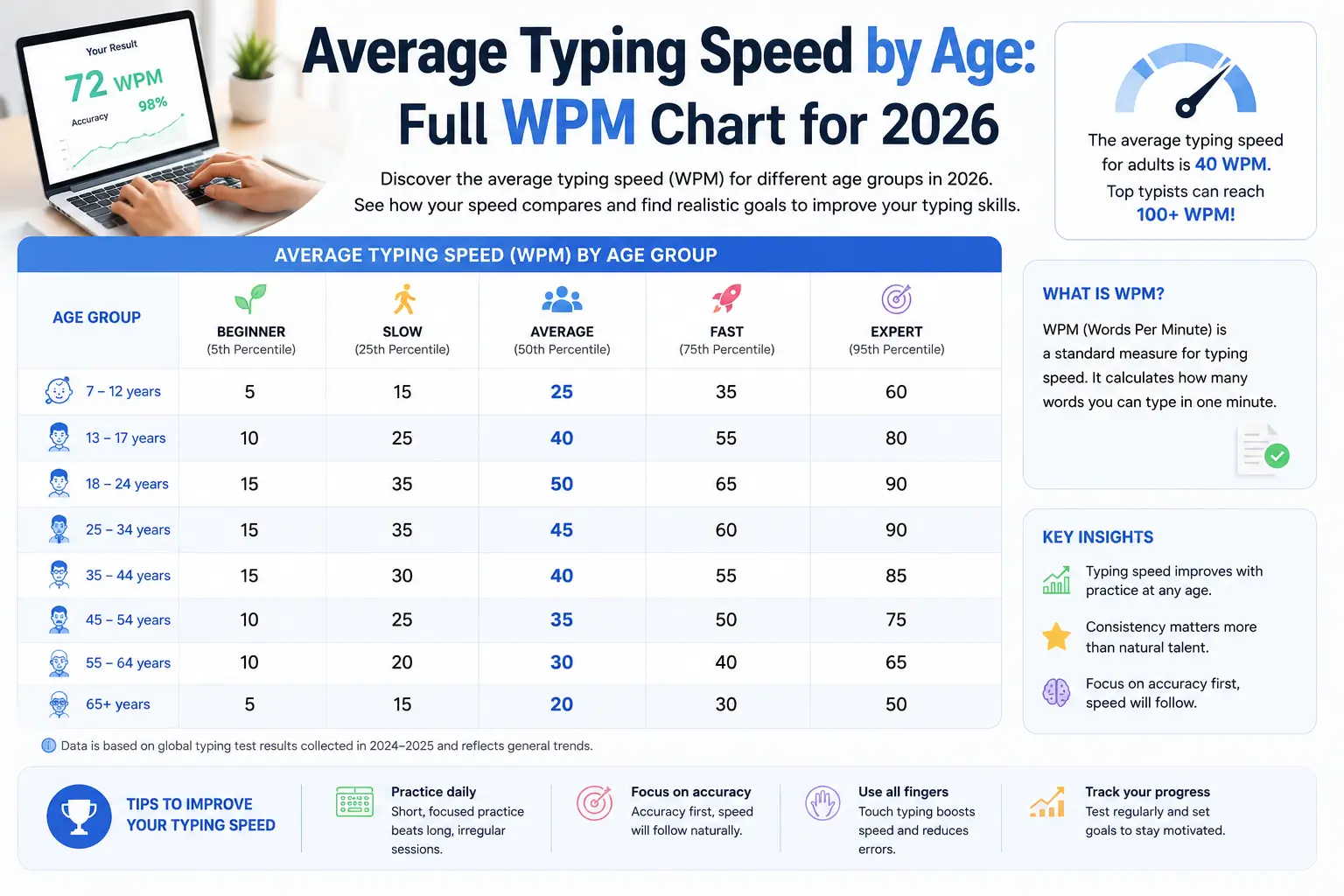
Wondering if you type fast for your age? The average typing speed sits near 40 WPM for adults, but it changes a lot from childhood to your senior years. This guide shows the full typing speed by age chart, real WPM benchmarks for kids, teens, and adults, and simple ways to check and improve your words per minute today.
Most people never learn where their typing speed stands. They just type and hope it is “good enough.” The truth is that a clear WPM chart by age helps you set a fair goal, spot slow habits, and track real progress. Let us break down every age group with honest numbers.
What Is the Average Typing Speed?
The average typing speed for adults is around 40 words per minute (WPM), with an average accuracy of about 92%. Global data from millions of tests puts the typical range between 40 and 52 WPM.
Here is a quick fact most people miss. One “word” in any typing test equals 5 characters, including spaces. So 40 WPM means you type 200 correct characters every minute.
If you want to know your own number first, take a quick one minute typing test before you read the chart. It takes just 60 seconds and gives you a real score to compare.
Average Typing Speed by Age Chart
Typing speed grows fast in childhood, peaks in your 20s and 30s, then drops slightly with age. Below is the full typing speed by age chart based on current benchmarks.
| Age Group | Average WPM | Typical Range | Stage |
|---|---|---|---|
| 5 to 6 years | 5 WPM | 3 to 8 WPM | First keys |
| 7 to 8 years | 12 WPM | 8 to 17 WPM | Learning words |
| 9 to 10 years | 15 WPM | 10 to 22 WPM | Building rhythm |
| 11 to 12 years | 22 WPM | 18 to 33 WPM | Touch typing starts |
| 13 to 14 years | 32 WPM | 22 to 42 WPM | Faster teens |
| 15 to 17 years | 40 WPM | 28 to 52 WPM | High school |
| 18 to 22 years | 48 WPM | 44 to 60 WPM | College peak |
| 23 to 30 years | 55 WPM | 45 to 70 WPM | Speed peak |
| 31 to 50 years | 58 WPM | 50 to 65 WPM | Best accuracy |
| 51 to 65 years | 50 WPM | 40 to 60 WPM | Steady and clean |
| 65+ years | 42 WPM | 35 to 50 WPM | Careful and precise |
Key takeaway: Raw speed peaks in your 20s, but accuracy actually gets better with age. Older typists make fewer mistakes, so their real output stays strong.
Typing Speed by Age for Kids

Kids follow a simple pattern called the 5 per grade rule. Their speed climbs about 5 WPM for each school grade.
- 1st grade: 5 WPM
- 2nd grade: 10 WPM
- 3rd grade: 15 WPM
- 4th grade: 20 WPM
- 5th grade: 25 WPM
This rule is very accurate through elementary school. It works because a child’s speed is limited by finger growth, not by effort.
- Important tip for parents: Do not push speed too early. A child who types 22 WPM at 98% accuracy beats a child who types 30 WPM at 80% accuracy. The slow, clean typist wastes less time fixing errors.
The best window to learn touch typing is ages 8 to 12. Kids this age are old enough for real lessons but young enough to skip bad hunt and peck habits. A child who practices 15 minutes a day can hit 40 to 50 WPM by age 12.
Typing Speed by Age for Teens
Teens type faster than most adults. Daily gaming, texting, and school work build strong keyboard habits.
| Teen Age | Average WPM |
|---|---|
| 13 years | 27 WPM |
| 14 years | 33 WPM |
| 15 years | 36 WPM |
| 16 years | 40 WPM |
| 17 years | 42 WPM |
Teens who play computer games type 15 to 20% faster than non-gamers. Games train hand eye coordination, which carries straight into typing.
For teens preparing essays and exams, 50 WPM is a smart target. It keeps typing from slowing down their thinking. A paragraph typing test with real sentences is the best way for teens to practice for school work.
Average Typing Speed for Adults
The adult average holds steady near 40 WPM in controlled tests. On typing websites, self reported scores look higher at 50 to 55 WPM, but that number is inflated because fast typists test more often.
Here is what different adult speeds really mean:
- Below 30 WPM: Slow, likely hunt and peck typing
- 40 WPM: Average and fine for daily tasks
- 60 WPM: Faster than 75% of adults
- 80 WPM: Professional level
- 100+ WPM: Expert, competition ready
If you sit below 40 WPM, do not worry. Typing is one of the easiest skills to improve. Most people gain 5 to 10 WPM per week with short daily practice.
Typing Speed by Job and Profession
Your job shapes your typing speed. Some roles demand high WPM, and daily practice pushes those numbers up.
| Profession | Typical WPM | Minimum Required |
|---|---|---|
| Office worker | 38 to 45 WPM | 40 WPM |
| Data entry clerk | 60 to 80 WPM | 50 to 60 WPM |
| Executive assistant | 55 to 75 WPM | 60 WPM |
| Programmer | 50 to 70 WPM | No fixed rule |
| Writer or journalist | 60 to 90 WPM | No fixed rule |
| Transcriptionist | 80 to 100 WPM | 75 WPM |
Real world tip: Most office and data entry job posts list 50 to 60 WPM as the minimum. If you are job hunting, aim for 45 WPM with 97% accuracy to stay safe.
For government exam typing tests like SSC and CPCT, the rules are stricter. Our exam mode typing test copies the real exam formula so you know your true score before test day.
Raw WPM vs Net WPM: What Really Counts
Many people measure the wrong number. Raw WPM counts every word you type, even the wrong ones. Net WPM subtracts your mistakes. Real exams and jobs care about net WPM.
Here is the simple formula:
Net WPM = (Total correct characters ÷ 5) ÷ minutes
For example, if you type 250 correct characters in one minute, your net WPM is 50. Every error you make lowers this number, so accuracy always matters more than raw speed.
How to Improve Your Typing Speed
Getting faster is simple when you follow the right steps. These methods work at any age.
- Learn touch typing: Use all 10 fingers and keep your eyes on the screen, not the keyboard.
- Focus on accuracy first: Speed follows clean habits. Never rush past mistakes.
- Practice 15 to 20 minutes daily: Short, focused sessions beat long, tiring ones.
- Warm up before real work: Two minutes of typing gets your fingers ready.
- Track your progress: Test at the start and end of each session to see growth.
The fastest way to improve is regular testing on real text. Try a fresh English typing test each day and watch your WPM climb week by week. If you want to practice on your own material, the custom typing test lets you paste any text you like.
What Is a Good Typing Speed for My Age?
Here is a simple way to judge your score:
- Kids under 12: Match your grade using the 5 per grade rule
- Teens 13 to 17: 35 to 45 WPM is solid
- Adults 18 to 50: 50 to 60 WPM is above average
- Adults 51+: 40 to 50 WPM with high accuracy is excellent
Remember, age is one of the weakest factors in typing speed. Practice and technique explain almost all the difference between a slow and fast typist. A motivated 50 year old who drills for a month will out type a 20 year old who never learned the home row.
Frequently Asked Questions
What is the average typing speed by age?
Average typing speed climbs with age. A 9 year old types around 15 WPM, a 12 year old around 24 WPM, teens reach 30 to 45 WPM, and adults average near 40 WPM. Speed peaks in the 20s and 30s, then drops slightly with age.
What is a good typing speed for a 14 year old?
A good typing speed for a 14 year old is 32 to 35 WPM, with a normal range of 22 to 42 WPM. Teens who use computers often for gaming and school usually land at the higher end.
Is 40 WPM a good typing speed?
Yes, 40 WPM is average and fine for daily computer use, social media, and casual work. For office jobs, 50 to 60 WPM is preferred. For data entry roles, 65 to 80 WPM is often required.
What is the average typing speed for adults?
The average adult types 40 WPM in controlled tests, with a global range of 40 to 52 WPM. Accuracy sits near 92% on average. Office workers who type daily often reach 50 to 60 WPM.
How can I test my typing speed by age?
Take a free timed test to check your WPM against your age group. A one minute typing test gives you an instant score with accuracy, so you can compare it to the age chart above.
Does typing speed drop with age?
Raw speed peaks in the 20s and 30s, then drifts down slightly. But this is mostly from less daily typing, not age itself. Older typists gain better accuracy, which keeps their real output strong.
Final Thoughts
Your typing speed by age is just a starting line, not a final grade. The chart tells you where the crowd sits, but where you land is mostly up to you. With 15 minutes of daily practice, anyone can beat their age average within weeks.
The smartest move is to test today, note your score, and check again in a few weeks. That trend over time tells you far more than any single number. Ready to see where you stand? Take a free typing speed test now and find out your real WPM in seconds.